Thursday, 1 March 2012

Speech & Drama can help at interviews


I had the experience of going with my first son to an interview for university this week.  He had only applied to one place - he said it was the only  place that did exactly what he wanted!  So huge pressure and huge competition on all of us but particularly him.  When we drove to the university, I could feel his nerves; he was pale and quiet and felt sick.  So it made me think how can Speech and Drama help with interview nerves?

Here are my five top tips:

1  Relaxation.  Part and parcel of Speech and Drama is relaxation.  We teach our students about the voice and how it works.  Part of this is relaxing and learning to breath deeply.  This is a brilliant tool for calming nerves.  Learning to relax, having it as something which you can switch on when needed is an invaluable tool

2. Feeling comfortable speaking with an adult in a one to one environment.  We are rarely in this type of formal situation as young people.  Our work is often in groups and we are usually tested by written test. In any speech and drama exam we teach children how to answer questions, even answering them in character and they learn how to answer fully and with confidence. 

3. Using our imagination to understand how others feel and how we come across.  Often, students who are shy or slightly unconfident will find working on speeches and 'becoming' someone else helps them to understand what reactions to different behaviors can be.   They can learn how to LOOK confident through pretending to be someone else.

4. Part of the Speech and Drama exam is a discussion with the examiner.  We can prepare for this by looking at the subject and reading around it, having mock discussions and practising for the unknown.  This simulates an interview in a safe and reassuring environment.

5. Improvisation. In the later grades young people as asked to improvise with only a few minutes preparation time.  They learn to think on their feet, organise their thoughts and take risks. Some of these improvisations can be in groups and again if they go to any places which ask for group interviews or workshops this preparation will be invaluable to them. 

Take  the plunge - email me for recomendations....

Tuesday, 21 February 2012

Roadtrip


My friend Violetta Gyra has developed a play that takes place inside 4 cars and takes a real roadtrip on the streets of Athens. Here is what she says about it:


ROADTRIP is a play that takes place inside 4 cars and takes a real roadtrip on the streets of Athens. 
Four different stories that bring us closer.

With vehicle, a real car, an elliptical space-time, familiar to all of us, and driven by our common anxiety about tomorrow!
 
In ROADTRIP we transform a simple car into a moving stage.

Put your seat belts on! Off we go!
Everything takes place on the streets. On the road. I run, you run, we run. And while everyone chooses his own path - his own trip- we all end up, by momentum to go through the same “trip”. Happiness, money, success, recognition. And our relationships? Do I have what you want? Do you have what I need? And if we both want it....can we make it? We are all on the run, constantly, our lonileness, our insanity.
We coexist, we are searching...we desire! Can we manage to move, to grow in parallel worlds?

ROADTRIP's pilot version was presented @ kinitiras studio (www.kinitirastudio.com) this past June during the in progress festival.

We are about to begin our next “trip” : follow our path... stay in touch and become
our next audience!
Impressed by this idea I have taken it and developed it into a workshop for young people.  Here is my plan.

Warm up - play a game like Penguins (contact me if you want the details)

Split into groups of 4 or 5 and place chairs in two rows like a mini car. Ask the group to choose a driver and then start to improvise.

1. You dont know each other or why you are all in the car together you have 4 minutes to get to know each other and to create a story without discussing it first. Repeat this after 4 minutes.

Have a 2 minute chat in the group about what might change and spend 15 minutes working this through.

2. Add an obstacle for example having to stop at a petrol station where something happens.

3. Add another - meeting up with one of the other groups in their car, having an argument and swapping cars. Why did you have to swap and what happens?

Rehearse and show the rest of the workshop what you have done.

You could extend this by writing a script about your journey or by inviting audience members to be in the car and finding out what would happen when you change the dynamics.


This is a simple idea which has multiple uses so thanks to Violetta for her inspiration.


Sunday, 19 February 2012

Why be a tree?


One of the biggest jokes for any stand up routine on doing drama at school or university is being asked to be a tree.

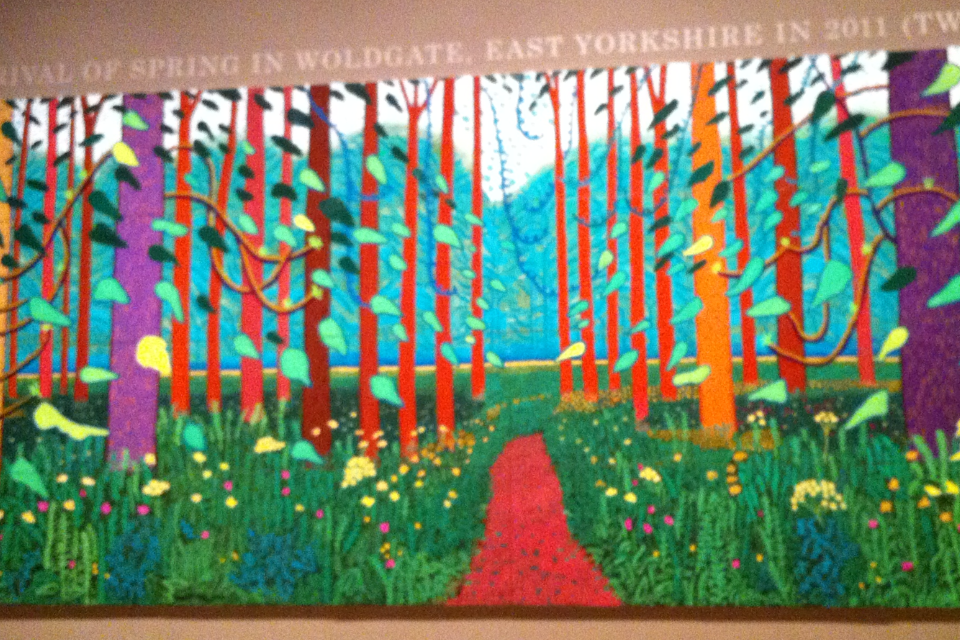
This week I went to the Hockney exhibition which made me consider being asked to be a tree in drama as a child. Most of us made the same shape as that of the yoga position. Some people are very good at it as I remember from a beach in Devon where my dog peed on a woman in a black wet suit who was in the yoga tree pose on the beech. We were very embarrassed when we had stopped laughing but she had a great sense of humour and simply shrugged it off thank goodness.

For many of us though - and all jokes aside - drama has moved on. Looking at Hockney, his exhibition is all about changes in seasons and I stopped to consider how this could be used as a stimulus for drama sessions. Still images are a wonderful way into drama.

We can use ideas of change with students to look at their own lives. Ask them how they would show family life, creating still images through drama and asking them to portray relationships and change. We can incorporate this into working with texts as well.

For more stylised work we could look at how pictures can be represented as a 3d image in a workshop. Perhaps ask the group to choose 5 pictures as individuals or together and then ask them to represent them and move from one to the other using space, levels and movement. You could add sound to give a sense of movement and flow and to add another sensory level to creating the pictures.

This could also be used as part of devising a scene - it may have a different perspective and theme but could be about change and growth and therefore relate to the themes Hockney was exploring in his paintings.

So we may ask children to be trees but we can do so much more than that.........


Tuesday, 14 February 2012

Holidays with drama


I’ve been going to the Theatresaurus summer courses for two years now – as long as it has been running. On my first visit, I was surprised how quickly I made friends with everyone there, even the children quite a few years younger than me!

On our first day, we did ice-breakers. Games that all of a sudden made us become friends, work as a team, and find out a little bit about each other, without us even knowing it. We played games for the first half of the day, and then we got to ‘work’. I put this in inverted commas for it didn’t feel like work, it still felt like a game, devising an improvisation from three words (such as Key, Police and Cheese Sandwich – and it was actually quite good!).

The next day we did even more games, to get us to start exercising our vocal chords, making sure we were using intonation, projecting our voices, hand gestures, body language etc. We also started thinking about what type of examination we would do; Single: single Shakespeare, single modern, Duo: duo Shakespeare, duo scripted, duo devised (Where you come up with an improvisation from a stimulus) Group: group Shakespeare, group scripted, group devised.
The first  year, I chose to do a duo scripted piece. We passed our Grade 4 (Ros chooses which grade) with a distinction. I was really sad to go as the friends I had made had strengthened over time. Sure, it hadn’t been for that long, however spending so much time together every day for ten days does that kind of thing.

The next year, I was feeling much more confident, because I knew what to expect. Do you know what? It was better. I came back greeting all of my old friends, and the new. I had no qualms at instantly being friends with them this run around– instead of the shy thing in the corner I was the last time!

Spurred on by last year’s success, I opted to do a singular Shakespeare piece. My task at Grade 5 was: To do two Shakespeare monologues from different genres, to be ‘hot seated’ (asked questions in the role of a character). I chose to do Puck’s ‘Thou speakest aright!’ Act 2 scene 1 and Juliet’s ‘The clock struck nine’ Act 2 scene 5. Again I got a distinction.
What is funny is how everyone who did this course did really well, distinctions all round.

Rosa aged 12. 


Friday, 10 February 2012

Of Mice and Cheese


Using puppets in drama to tell stories has a long history from Punch and Judy shows through to the wonderful use of puppets at the National theatre in adaptations such as Philip Pullman's His Dark Materials. Puppetry enables animals, magical creatures and people of a different scale and timeline to come to life and move in ways which may not be possible for actors. They can help children talk about events which otherwise would be too painful or to explore worlds of enchantment and imagination setting them free from constraints of time, space and identity. The imagery of the puppets can also be used as a starting point to create drama as in the 5 uses of a cheese and mouse puppet. 


1.  Pass the puppet around the circle, using one line only each, tell a story, building on what the person before you says.

2.  Pass the puppet around the circle each person telling a story about why the mice are in the cheese, what happened  to them, where are they now and why are they there.

3.  Change the focus - these mice are people - trapped in this small place - why?  In groups get the students to explore why people might be trapped - throw in ideas - Prison, Orphanage, mental institution.  Get students to begin an improvisation of a group of people being trapped.

4.  Physical theatre - using the idea again of being trapped,  ask the students to physically put them selves close together at all sorts of different angles  - they cannot move without another person scrunching up - limit their space - no talking.  Add music, add single words, add text

5. For younger children (from age 6)  Make up a story of the 5 mouse and the cheese- and as you are telling it get the children to act out what you are saying.  They could use some still image.  This could lead on to drawings and they could finish the story in all sort of different ways.


Monday, 6 February 2012

Be not afeard; the isle is full of noises


The London Olympic theme is taken from the Tempest a play full of real passion and thematic tensions. At Theatresaurus we have run some courses and workshops on the Tempest as it is an amazing ensemble piece for all age ranges and  a fabulous way of talking about issues such as racism and bullying, freedom, control and democracy.

Danny Boyle - the oscar winning director of Slumdog Millionaire - is having a bell at the centre of the stadium inscribed with the quote "be not afeard; the isle is full of noises." IN this scene Caliban is talking to Stefano and Trinculo and telling them not to be afraid of the Island as it is lovely but that they need to get rid of Prospero the benevolent dictator in order to make things really perfect and give them control of the Island.

It seems that Boyle is concentrating on the  love of country rather than the battle against a benevolent dictator as central to the theme of the games. However, he has said that the theme will also be about cleansing a poisoned land (concentrating on the Olympic park being cleansed of industrial pollutants) which echoes Calibans struggles to free his Island.

Caliban is passionate about enjoying his heritage and being able to be proud of the Island he lives on and this is something which our workshops often touch on. What are we proud of in the world, our lives and families and how can we make it better?

One of the other central themes in The Tempest is of course the weather which is another national hobby. There is never a day in Britain which is perfect! Someone will always have some comment or other over it being too hot, cold, muggy,icy,windy etc. The effect of weather in our psyche and on our National mood is an interesting one and something we are famous for around the world.

Caliban is called "this thing of darkness" in the Tempest and the play deals with the inherent racism in this statement.  Teachers often have difficulty in perceiving racism and can even pursuing a colour blind approach seeing not making an issue of children's racial and ethnic heritage as being fair. However, actually talking about the issue is both healthy and is often easier through plays such as the Tempest because it allows for open discussion of the unequal relationship between Prospero and Caliban and the differences in their looks and status. This can lead to discussions as to the effects of racism in the present which are non threatening and interesting.

Using Shakespeare as a vehicle to discuss such important issues also means that misconceptions and stereotypes can be addressed through acting and script work. There is a power in the storytelling of the play which draws in the participants and gets them intrigued in the themes presented to them.

Of course there are further themes to explore in the Tempest such as ageing, reconciliation and loss and each workshop can be scoped so that it meets the needs of the curriculum and brings a creative aspect both to the teaching of Shakespeare in schools and to the teaching of the PHSE curriculum and citizenship.

Lastly, the Tempest is a play of magic and wonder at the world and as Miranda remarks in Act 5 Scene 1

How many goodly creatures are there here!
How beauteous mankind is! O brave new world,
That has such people in't!


Monday, 30 January 2012

Choosing a monologue


When you go to an audition or when you are doing an exam choosing the right monologue can be the difference between good and very good.

Here are our top tips for monologues to help with your choice.

1. Dont look in a book of monologues everyone does that and it wont help you to stand out.

2. Use a book shop to browse such as the National Theatre book shop. Look and see if your local bookshop has a good theatre section and if not find one which does. Local theatres in the cities have bookshops as well. Try and find somewhere you feel comfortable looking at the plays and set some time aside to have a good read.

3. Talk to the people at these bookshops about plays with characters you are interested in.

4. Go to the theatre and watch plays and then buy a copy of the play you have seen and see if there is something you can adapt.

5. Try to get something which is in the same age group as you are.

6. Think about what it is you are trying to say in your monologue and work around that as well.

7. Consider your audience. You may choose something different when you are auditioning to when you are doing an exam.

Lastly here are a few ideas:

Female - young adult 

Tess from the Female of the Species (Joanna Murray-Smith) - pg 35,36,37 - can be made into a monolgue. Do contact us if you need help with this.

Angela from Like a Virgin ( Gordon Steel) - You just thought..........


Young girls 


Alice from Alice (Lucy Wade)

Men - young adult


Some great monologues in Jerusalem ( Jez Butterworth)

Herons (Simon Stephens)


Young boys 


My very own story (Alan Ayckbourn)

Please contact us if you want any further help at info@theatresaurus.co.uk